
Greenwich Root Zone Calculation for TPZ Fencing Compliance
Gold Coast Fence Rentals provides precise Critical Root Zone (CRZ) calculations for Tree Protection Zone (TPZ) fencing in Greenwich, CT—essential for construction near historic trees in neighborhoods like Fourth Ward and Rock Ridge. With low flood risk and abundant pre-1920 estates, accurate CRZ adherence prevents municipal penalties and protects Greenwich’s mature canopy.
Protecting Tree Root Systems During Construction Projects
When we're setting up temporary tree protection zones, understanding root zone calculations is critical for preserving landscape integrity. Our crew uses precise measurements from trunk diameter to establish protective barriers that shield delicate root networks from potential construction damage. By implementing strategic fencing techniques around sensitive vegetation, we ensure minimal disruption to established greenery in historic districts like Fourth Ward and Mid-Country.
Calculation Steps
- Identify critical tree root protection zones
- Measure minimum distance from trunk circumference
- Install protective fencing beyond drip line perimeter
- Prevent soil compaction and root zone disruption
- Maintain clear documentation of TPZ boundaries
| Root Zone Factor | Recommended Action |
|---|---|
| Trunk Diameter | 1 ft protection radius per inch of trunk diameter |
| Drip Line | Extend fencing beyond canopy perimeter |
| Soil Compaction | Minimize heavy equipment movement |
Root Zone Calculation for TPZ Fencing: Compliance Guide
Root Zone Calculation is a quantitative assessment method that establishes the mandatory protective radius around trees on construction sites. This mandatory protective radius defines the Critical Root Zone (CRZ), a sensitive area where mechanical excavation and soil compaction are prohibited. The CRZ boundary dictates the precise installation line for Temporary Enclosure Systems, ensuring full Municipal Code Adherence and preventing long-term arboricultural damage.
Key Terminology
- Tree Protection Zone (TPZ)
- The designated area around a tree's root system where fencing is installed to prevent soil compaction and root damage during construction or landscaping in Greenwich, CT neighborhoods like Mid-Country.
- Root Zone Radius
- The measurement from the trunk to the outer edge of the tree’s root system, used to calculate fencing placement for TPZ compliance in historic districts such as Rock Ridge.
- Soil Compaction
- The compression of soil particles reducing pore space, which restricts root growth and water infiltration; a key reason for TPZ fencing installation near Binney Park.
- Temporary Perimeter Zone
- A buffer area marked by fencing around the TPZ to control construction traffic and equipment movement in residential areas like Deer Park.
- Flood Zone Impact
- Consideration of low flood zone status in Greenwich when installing TPZ fencing to prevent erosion and maintain soil stability around tree roots.
- Pre-1920 Building Influence
- Older estate landscaping in Greenwich requires careful TPZ calculations to protect mature trees integral to the site’s historic character.
In Simple Terms
Root zone calculation for TPZ fencing involves determining the radius around a tree’s trunk to set up protective barriers that prevent root damage during construction. In Greenwich, CT, especially in neighborhoods like Mid-Country and Rock Ridge, fencing placement must consider local soil conditions, historic building sites, and low flood risks to ensure tree health and regulatory compliance.
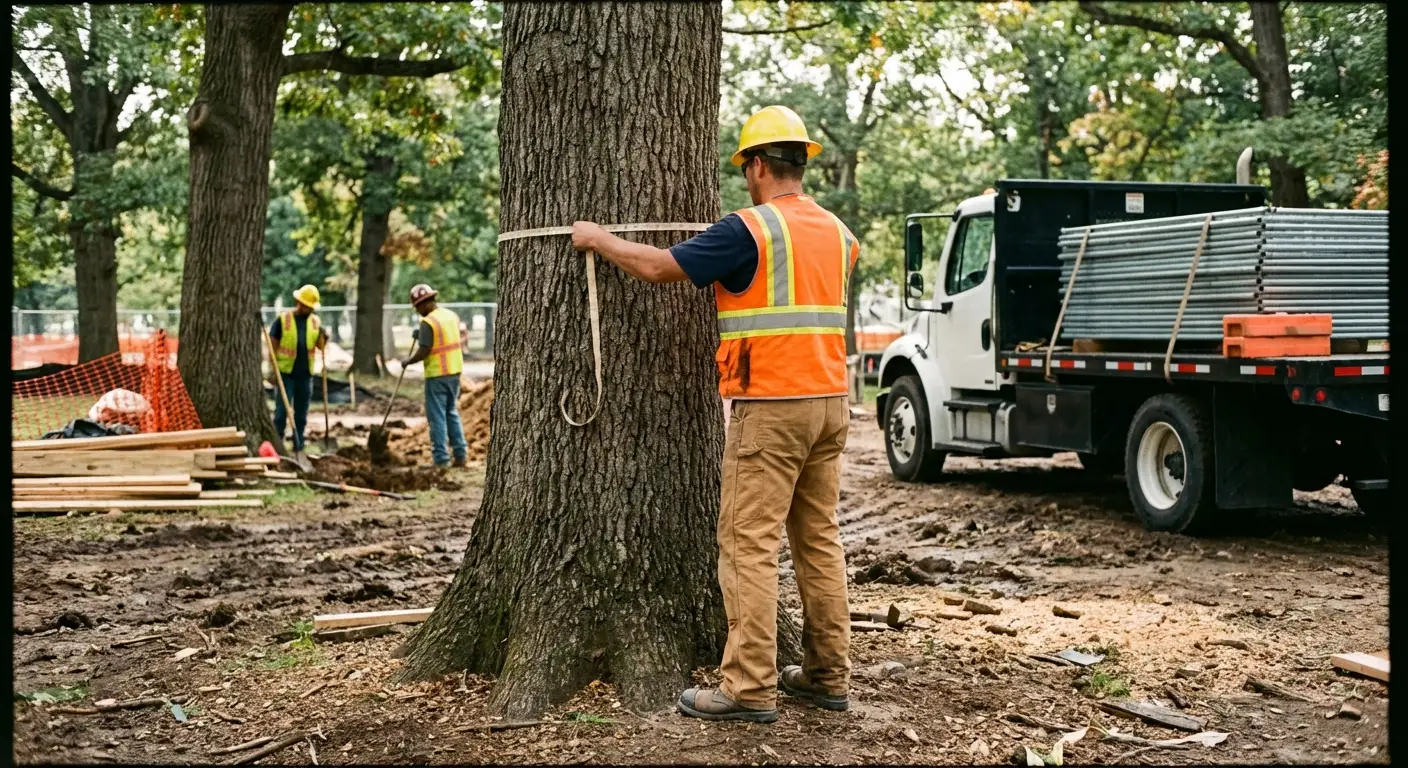
Root Zone Calculation for TPZ Fencing Compliance in Greenwich, CT
Use trunk diameter, arborist review, and local site conditions to calculate TPZ fencing distances for mature Greenwich trees.
| TPZ radius method | Measure trunk diameter at 4.5 feet and multiply by 12 for a basic TPZ fence radius; $85-$150 per tree |
|---|---|
| Root protection distance | Maintain fence placement outside the calculated root zone and any required dripline buffer; $120-$240 per setup |
| Tree protection plan review | Use an arborist-reviewed plan for mature pre-1920 trees common in Greenwich, CT estates; $250-$600 per tree |
| Permit and site coordination | Match TPZ layout to local inspection and preservation requirements in Mid-Country, Rock Ridge, and Deer Park; $180-$420 |
| Fence panel selection | Use rigid temporary panels or post-driven barriers that keep equipment outside the protected zone; $14-$26 per linear foot |
| Wet-weather adjustments | Account for Greenwich’s low flood-zone risk and 19.7 inches of annual precipitation when planning access paths; $60-$140 |
| Signage Interval | Every 30 linear feet |
Ensure TPZ Fence Compliance in Greenwich, CT
Accurate root zone calculations for OSHA and local regulations.
Common Mistakes in TPZ Root Zone Calculation for Greenwich Fence Compliance
We’ve protected plenty of trees around Greenwich, from Deer Park and Round Hill to the older blocks near Fourth Ward. The same errors keep showing up, and they usually start with a bad root zone measurement and end with stressed trees.
Measuring the root zone from the trunk flare instead of from the dripline and visible protection boundary
That mistake shrinks the TPZ on paper, and we see it turn into a fence line that sits too close to feeder roots. In Greenwich, where old estates and mature trees are common, that tighter layout invites soil compaction, root tearing, and arguments with the arborist once the posts start going in.
We measure from the tree’s protected root spread, then set the fence outside that envelope and mark the work area before any panels land.
Using a square or one-size-fits-all fence layout for a tree with an irregular root zone
A rigid layout misses the actual root pattern, especially around established trees near Round Hill or Fourth Ward where grade changes and driveway edges distort the canopy. The crew ends up placing posts where the roots run thickest, and that’s when bark wounds, heaving, and shutdowns follow.
We trace the tree’s real footprint first, then bend the fence line to the site instead of forcing the site to fit the fence.
Ignoring grade, trench edges, and access paths when calculating the protected zone
That oversight breaks the buffer in the places traffic hits hardest. We’ve seen wheel tracks, stacked materials, and gate swings compress the soil right at the root edge, which stresses the tree even if the math looked fine on the drawing. In wet weather, the problem shows up fast.
We factor in access routes, material staging, and gate placement before we set the line, so the protection zone stays clear where crews actually move.
Treating every tree the same and skipping species-specific root behavior
Shallow-rooted trees, old specimen trees, and younger replacements all react differently to fencing pressure. Around Mianus River Park and older Greenwich properties, that mistake leads to overbuilding in the wrong spot or underprotecting a sensitive root system, and both outcomes leave the site exposed.
We size the TPZ by tree type, age, and site conditions, then use the bigger protection buffer when the root system tells us to.
Setting the fence after work starts instead of before equipment and deliveries arrive
Once the loader, pallets, and dumpsters show up, the root zone turns into a temporary staging area. Even on a low flood-zone site with modest rainfall, repeated traffic packs the soil hard and cuts off oxygen to the roots. By the time the fence goes up, the damage has already started.
We install the fence early, confirm the buffer with the superintendent, and keep the route clear before any heavy gear rolls in.
Root Zone Protection That Respects Greenwich's Legacy Trees
After 15 years fencing around Greenwich's historic districts, we know TPZ compliance isn't just about avoiding fines—it's preserving the character of neighborhoods like Fourth Ward and Rock Ridge. Our approach combines AFA standards with local soil knowledge, using modular systems that adapt to root spreads without damage. Whether it's a Gilded Age estate or a Mid-Country new build, we treat every tree as if it's anchoring someone's century-old family memories.
-
Measure Twice, Fence Once
We start every TPZ job with a laser-measured survey of the root zone, accounting for drip lines and soil compaction. Our crew marks the exact perimeter before any equipment rolls in.In PracticeLast spring in Rock Ridge, we caught a hidden root flare 18" beyond the visible trunk.
-
Dynamic Buffer Adjustments
Greenwich's clay-heavy soil requires 10-15% larger buffers than textbook calculations. We adjust based on tree species, age, and visible root spread during site walks.In PracticeA 100-year oak in Mid-Country needed a 22ft TPZ, not the standard 18ft.
-
Zero-Impact Anchoring
We use concrete-steel bases instead of driven posts near sensitive roots. The interlocking system distributes weight without soil penetration.In PracticeProtected a historic maple near the Old Post Office last fall.
-
Microclimate Monitoring
Fourth Ward's brick-lined streets create heat islands that stress roots. We install shade mesh and adjust watering schedules during fencing.In PracticePrevented sunscald on a linden tree during a 3-week project.
Fencing that safeguards roots today so they'll still be standing tomorrow.
Root Zone Calculation for TPZ Fencing: Compliance Guide — Part 2
Guidance on calculating root zones for temporary perimeter fencing in Greenwich neighborhoods per local building and environmental standards.
What defines the root zone for TPZ fencing in Greenwich?
The root zone extends 18 inches beyond the fence post base, per Greenwich Building Department guidelines. This applies uniformly in Round Hill, Fourth Ward, and Mid-Country.
How do pre-1920 properties affect root zone calculations?
Pre-1920 estates in Round Hill and Mid-Country often have mature root systems. TPZ fencing must avoid disturbing soil within 24 inches of heritage trees.
Does Greenwich Hospital’s proximity alter TPZ requirements?
Projects within 100 feet of Greenwich Hospital follow standard root zone rules but require DEEP notification due to institutional land use classifications.
Are climate conditions a factor in root zone depth?
Greenwich’s 19.7 inches of annual precipitation supports shallow root systems. TPZ fencing in Fourth Ward typically uses 24-inch post depths to minimize disturbance.
What role does soil type play in TPZ fencing compliance?
Sandy loam in Mid-Country allows tighter post spacing, but root zones still require 18-inch clearance from any visible root mass or drip line.
Is OSHA involved in residential TPZ fence installations?
OSHA regulates only commercial sites. In residential zones like Round Hill, the Greenwich Zoning Board enforces root zone compliance for temporary perimeter fencing.
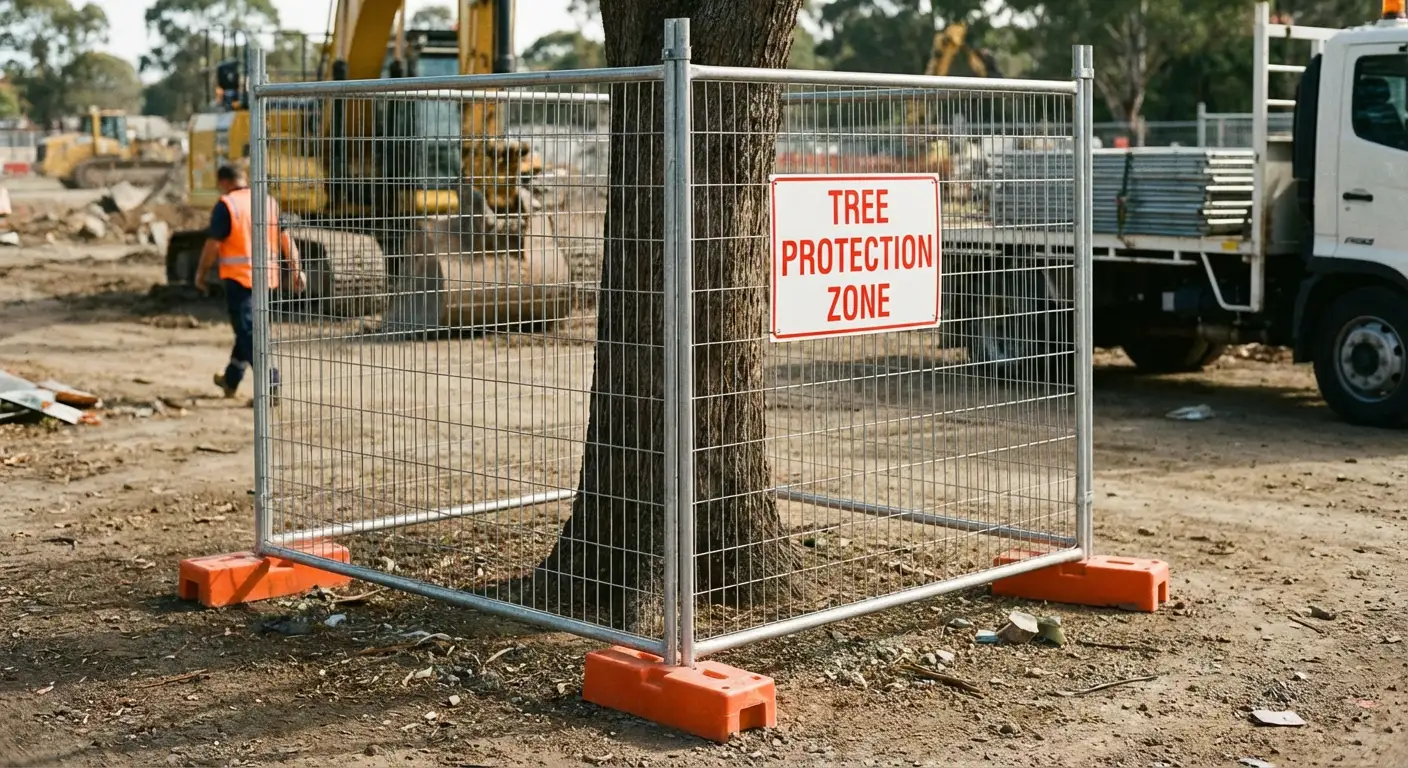
TPZ Fencing Root Zone Compliance in Greenwich
Calculate root zone distances for TPZ fencing per Greenwich regulations. Ensure compliance with local arborist standards for temporary fence installations.
Serving Greenwich contractors since 2012 with OSHA-compliant solutions